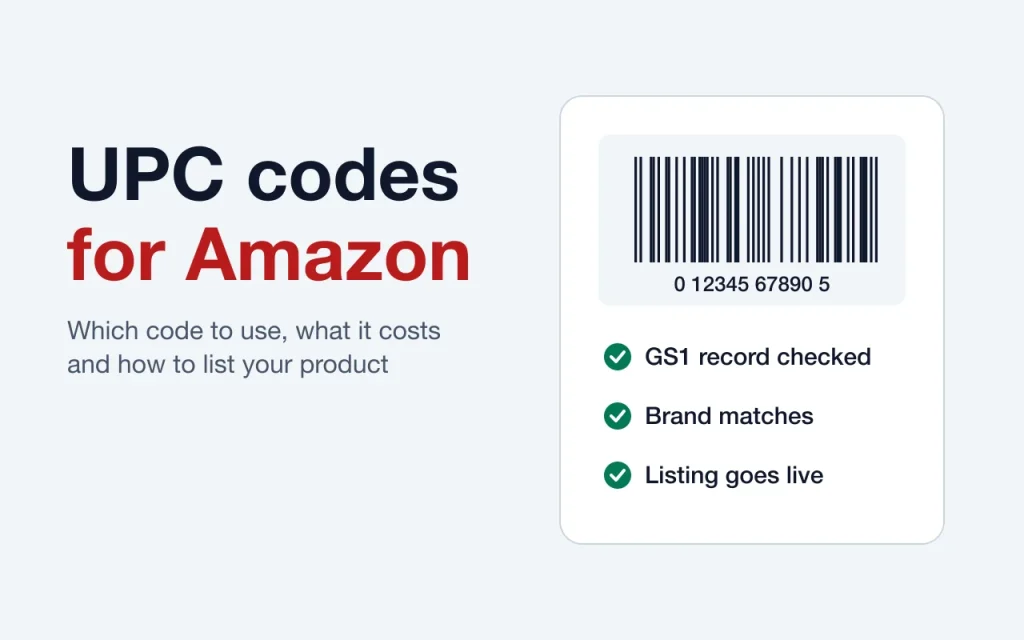
To list a new product on Amazon in 2026, you need a UPC or EAN that Amazon can match to your brand in GS1’s database, or an approved GTIN exemption. Codes licensed to your own company by GS1 pass that check most reliably. Reseller codes can be blocked, because GS1 records show the original licensee, not your brand.
The rules tightened in 2026. Since March 31, resellers sending stock to FBA must put an FNSKU sticker on every unit, while brand owners with GS1 codes and the Brand Representative role in Brand Registry can skip it.
The short answer by seller type
Most “UPC for Amazon” advice treats every seller the same. Your answer depends on whether you own the brand and whether the product already carries a barcode.
| Your situation | What to use on Amazon | Should you buy codes? |
|---|---|---|
| Wholesale, retail arbitrage or online arbitrage of another brand | The manufacturer’s UPC already on the box. List on the existing ASIN | No. Never put your own code on someone else’s product |
| Private label brand, selling mainly on Amazon | GS1 codes in your company name | Yes, from GS1 directly |
| Own brand, product has no barcode (handmade, custom, made to order) | GTIN exemption | Usually not |
| Bundle of other brands’ products | GTIN exemption, which covers bundles | Usually not |
| Small brand selling mostly on Shopify, eBay, markets or your own site, testing Amazon | Reseller codes off Amazon; GS1 or an exemption for the Amazon listing | Depends on how much of your sales Amazon is |
| Brand heading to Walmart or retail chains as well | GS1 codes in your company name | Yes, from GS1 directly |
If you’re in the first row, stop here. You don’t need to buy anything. Read the FNSKU section further down, because the 2026 change hits resellers hardest.
How Amazon checks a UPC
Amazon checks each product ID you enter against GS1 data. An Amazon staff member put it plainly in the Seller Forums: “UPCs must be registered in the GS1 database to be seen as valid” (Glenn_Amazon, Listings Lounge). The same post says the GS1 record has to match what you gave Amazon, including the brand and the UPC owner, and that the match is case sensitive.
Another staff reply goes further: “Amazon only allows UPC’s bought directly from GS1 to be used on our site” (Michelle_Amazon).
You can run the same kind of lookup yourself. Verified by GS1 is GS1’s public registry, and a search “will return, at a minimum, information about the company, organisation or person who assigned the GS1 GTIN” (GS1 support). It’s free for up to 30 queries a day (GS1 support).
What a blocked listing looks like
The most common message is error 8572: “You are using UPCs, EANs, ISBNs, ASINs, or JAN codes that do not match the products you are trying to list” (Seller Forums thread). Amazon may also open a case and ask for proof. One seller quoted the request word for word: “A copy of the certificate issued to you by GS1 showing your legal entity and associated GTIN prefix(s)” (Seller Forums thread).
The fix steps for each message are in our help articles on why Amazon rejects a UPC and common Amazon UPC errors, so they aren’t repeated here.
Even GS1 codes can fail
A GS1 code is the strongest option, not a free pass. Three things trip up sellers who did buy from GS1:
- Timing. Amazon’s system needs time to sync with GS1, so a code bought this morning may not validate today. Amazon staff agreed with this in the 8572 thread.
- Brand spelling. “Acme Home” in GS1 and “ACME Home” in Seller Central is a mismatch, because the check is case sensitive.
- Generic products. A seller with GS1 codes on an unbranded 20-pack still got rejected. Staff said Amazon likely couldn’t verify the UPC belonged to that seller “as the product is generic” (Seller Forums).
There’s also an old catalog problem. Some genuine GS1 numbers are already attached to ASINs created years ago by sellers who used unofficial codes, so the real owner gets rejected (Seller Forums thread). It’s rare, but if it happens to you, open a case with your GS1 certificate ready.
Reseller codes on Amazon, honestly
Reseller UPCs are real GS1 numbers. GetUPCCode’s codes come from UCC (now GS1) company prefixes licensed before August 28, 2002. Under the 2004 UCC fee settlement, those prefixes owe no renewal fees, which is why the codes have no yearly fee and each one is sold once.
Here’s the part that matters for Amazon. Our codes are not registered to the buyer’s company in GS1’s database. Look one up in Verified by GS1 and it shows the original prefix licensee, not your brand.
Amazon compares that record with your brand field, so a reseller code can be blocked, trigger a request for a GTIN exemption, or prompt Amazon to ask for GS1-issued codes. No reseller can promise otherwise, and you should be wary of any that does.
Seller reports are split. Steve Chou of MyWifeQuitHerJob wrote that he never had a problem with reseller codes (his guide), though that post dates from around 2019. In another forum thread, one seller reported several thousand old reseller codes with no issues, while a GS1 license holder said it had asked Amazon to take down hundreds of listings from sellers using codes licensed to its company (Seller Central Europe).
Who can reasonably use reseller codes
- Sellers whose main channels are Shopify, eBay, a website, craft fairs or local shops that only need a scannable number.
- Businesses that want barcodes for their own stock control or point of sale.
- Sellers testing a product on several channels before committing to GS1, who accept that the Amazon listing may need GS1 codes or an exemption later.
Who should go to GS1 directly
- Any brand where Amazon is the main channel or the main source of revenue.
- Anyone enrolling in Brand Registry who wants to send stock to FBA without FNSKU stickers (see the 2026 change below).
- Brands that plan to sell on Walmart, which cross-references the GS1 database and asks for GS1 company prefix codes in onboarding.
- Brands pitching retail chains, which often want GS1 codes in your own company name.
If you’re unsure which side you’re on, our comparison of GS1 and reseller barcodes covers the tradeoffs in more detail.
What UPC codes cost for Amazon sellers
“Cheap UPC codes for Amazon” is the most searched version of this question, so here are real numbers. The cheapest Amazon-safe option for a small catalog is a GS1 US single GTIN at $30 with no renewal fee (GS1 US).
| Option | 1 product | 10 products | 100 products | Renewal | Registered to your company in GS1 |
|---|---|---|---|---|---|
| GS1 US single GTIN | $30 | $300 | $3,000 | None | Yes |
| GS1 US company prefix | Not sold for 1 | $250 + $50/yr | $750 + $150/yr | Yearly | Yes |
| GetUPCCode reseller codes | $4.59 | $15 | $44 | None | No |
Sources: GS1 US fees and our UPC code price list. For every pack size and the five-year math, read how much a UPC code costs.
The math most guides skip
For a US seller with eight or fewer products, single GS1 GTINs beat a 10-code prefix. Eight GTINs cost $240 once. The 10-code prefix costs $250 up front, then $50 every year you keep it.
At nine or ten products the prefix starts cheaper on day one, but the renewal catches up. Ten single GTINs are $300 forever; the prefix is $300 after its first renewal and keeps climbing. Buy single GTINs if your line is small and stable, and buy a prefix if you’ll launch new variants every season.
A $4.59 code that Amazon blocks is not cheaper than a $30 GS1 GTIN. It’s $4.59 plus a relisting, plus the $30 anyway. For Amazon-first brands, start with GS1. For everything else, a reseller code at a few dollars is a fair deal, and you get the UPC and EAN-13 versions together.
Run your own numbers
Set your product count and how long you’ll keep selling. If Amazon is only a side channel for you, switch the channel and the advice changes.
Your numbers
-
GetUPCCode
-
GS1 US single GTINs
-
GS1 US company prefix
Prices from GS1 US, checked October 30, 2026, and our current packs before coupons. A prefix shows a range because the last renewal may fall outside your years.
How to buy UPC codes for Amazon
- Count every variant. Each size, color and pack count is its own product and needs its own code. A T-shirt in 3 colors and 4 sizes needs 12. A 12-ounce can, a 16-ounce bottle, a 6-pack and a 24-can case of the same drink need four.
- Pick your source using the seller-type table above. For Amazon-first private label, that’s GS1.
- At GS1 US, choose single GTINs or a prefix. Use the break-even above: eight or fewer stable products, single GTINs; more, or a growing line, a prefix.
- Register under the exact brand name you’ll use on Amazon. Same spelling, same capitals. This is the single most common cause of mismatches.
- Enter product data. A GS1 US GTIN includes a free lifetime GS1 US Data Hub subscription (GS1 US), which is where you assign each number to a product.
- Check the number in Verified by GS1 before you list. Confirm the company shown is yours and the brand matches your Seller Central entry.
- Give it time. If Amazon rejects a brand-new GS1 code, wait for the sync before you open a case.
If you buy reseller codes for Amazon anyway
Some sellers do, usually when Amazon is a side channel. These steps keep the risk small:
- Start with a small pack. Try one code on a real listing before you print packaging.
- Search each code on Amazon first. If another product comes up, don’t use that code. Ask the seller to replace it.
- Expect the GS1 lookup to show another company. That’s normal for a resold code, and it’s why Amazon may question it.
- Keep your invoice with your code list. It’s your proof of purchase if a dispute comes up.
- If Amazon blocks the code, stop resubmitting. Move to a GS1 code or apply for a GTIN exemption.
Our codes and prices are on the Amazon UPC codes page.
What the 12 digits mean
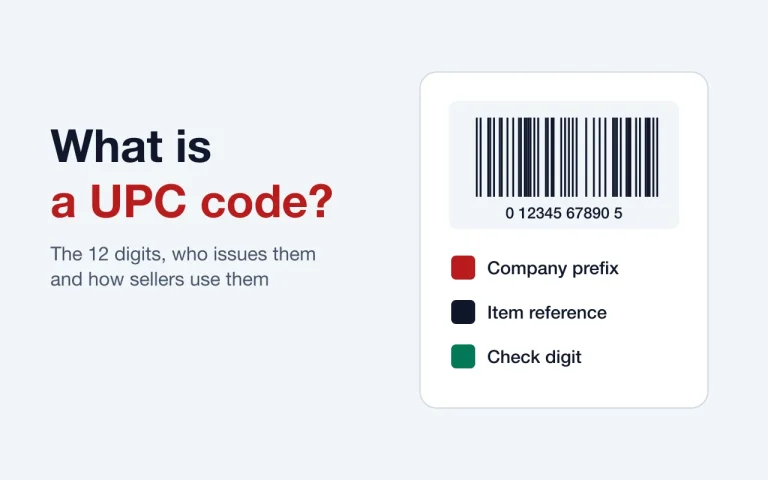
A UPC has three parts: a company prefix, an item reference and a check digit. The prefix identifies whoever licensed it from GS1, and it gets shorter as the number of codes it can hold grows. The item reference is the part assigned to each product. The twelfth digit is calculated from the first 11, so a scanner can tell when it has misread the number. You can test any code with our check digit calculator.
Do you also need a barcode image?
Not for the listing itself. Amazon asks for the number. You need the image when you put the barcode on packaging. GS1 US Data Hub creates one for a GS1 code, and resellers usually send image files with the order, but some cheap sellers don’t, so ask first. Our free barcode generator makes one from any valid number.
How to list a product on Amazon with a UPC
- Search the catalog first. Enter the UPC, brand and product name in Amazon’s search and in the Add a Product tool. If the product already has an ASIN, add your offer to it.
- Create a new listing only for a product that isn’t on Amazon yet. Choose the product ID type (UPC or EAN) and enter the full number, including the check digit.
- Match the brand field to GS1 character for character.
- Fill in the required attributes for the category and submit.
- If you get an error, don’t keep resubmitting with tweaks. Read the message, then follow the fix in why Amazon rejects a UPC.
- For FBA, decide your labeling before you create the shipment (next sections).
The full click-by-click version is in our help article on how to list a product on Amazon with a UPC.
Brand Registry and barcodes
Amazon Brand Registry is Amazon’s program for brand owners. To enroll, you need a pending or registered trademark for your brand name or logo, issued by the trademark office of a country that has an Amazon store. Pending applications are accepted in some cases, and Amazon’s IP Accelerator connects brands with vetted law firms to get a trademark faster (Amazon Brand Registry).
Brand Registry does not replace the UPC. You still need a GS1 code or an exemption to create listings. What it changes is your selling role.
Amazon has two selling roles. “The Brand Representative role is for internal, first-party sellers who are directly employed by the brand,” and the Reseller role is for authorized third-party sellers (Amazon, April 2025). If the trademark owner uses the same login for Brand Registry and Seller Central, the Brand Representative role is assigned automatically after enrollment. That role is what decides your FBA labeling in 2026.
GTIN exemption: when it beats buying a UPC
A GTIN exemption is Amazon’s permission to list a product without a UPC or EAN. It fits own-brand products that have no barcode, parts, and bundles.
Two limits catch people out:
- Your branding must be printed on the product or packaging. Amazon rejected one application because it did “not see sufficient proof that the branding is permanently affixed to the product and/or packaging” (Seller Central Europe). A sticker isn’t enough.
- Brands with GS1 barcodes can lose it. In one case Amazon revoked an exemption, explaining that “exemptions are not permitted as Amazon is expecting GS1 barcodes for products instead” (Glenn_Amazon).
An exemption is also Amazon-only. Walmart asks for GS1 company prefix codes in onboarding, and retail chains often want GS1 codes in your own company name. If you plan to sell anywhere else within a year, buying codes now saves relabeling later. Eligibility and the application steps are in our GTIN exemption help article.
The March 31, 2026 commingling change and your FNSKU
Commingling is when Amazon treats identical units from different sellers as one pool of stock, tracked by the manufacturer barcode. Amazon announced it would end that practice for inventory shipped on or after March 31, 2026 (News_Amazon, Seller Forums). Trade coverage describes it as a change to the US fulfillment network, with stock already in warehouses left as is (PPC Land).
An FNSKU is Amazon’s own barcode for your specific offer. Here’s who needs one now:
| Seller | Product has a manufacturer barcode (UPC, EAN, ISBN) | Product has no manufacturer barcode |
|---|---|---|
| Brand owner with the Brand Representative role | No Amazon sticker needed | FNSKU sticker needed |
| Reseller without the Brand Representative role | FNSKU sticker needed, even with the UPC on the box | FNSKU sticker needed |
Source: News_Amazon. GTIN-exempt products have no manufacturer barcode, so they fall in the right-hand column.
This is the biggest reason a private label brand should own its codes in 2026. A brand owner with GS1 codes and the Brand Representative role can ship stickerless. A brand owner on an exemption labels every unit.
Common Amazon UPC errors
You’ll see a handful of messages over and over: a code that doesn’t match the product, a code Amazon can’t find in GS1, a brand that needs approval, or a prompt to apply for a GTIN exemption. Each has its own fix, and a wrong fix can make the next attempt worse. Work through them with common Amazon UPC errors before you contact Seller Support.
When you do open a case, Amazon staff suggest including a screenshot of the error, the brand name, the full product title, the UPC, and your GS1 certificate or a screenshot of the GS1 record showing the code and its owner (Glenn_Amazon).
Frequently asked questions
Do I need a UPC to sell on Amazon?
For most new listings, yes. Amazon asks for a product ID such as a UPC or EAN that it can validate against GS1 data. Resellers use the manufacturer’s existing code. Brand owners whose products carry no barcode can apply for a GTIN exemption instead, which lets them list without one on Amazon only.
Can I use the manufacturer’s UPC when I resell a product?
Yes, and you should. If you sell another brand’s product, list it on the existing ASIN using the barcode already on the packaging. Never assign your own code to a product you didn’t make. Since March 31, 2026, resellers without the Brand Representative role also need FNSKU labels for FBA.
Does Amazon accept cheap UPC codes from resellers?
Sometimes, but you can’t count on it. Amazon checks codes against GS1 records, and a reseller code shows the original licensee, not your brand. That mismatch can block a listing or lead Amazon to ask for GS1-issued codes. For Amazon-first brands, a $30 GS1 US single GTIN is the safer buy.
What is a certified UPC code for Amazon?
Amazon doesn’t certify UPC codes. When Amazon asks for proof, it wants a certificate issued by GS1 showing your legal entity and your GTIN prefix, or a screenshot of the GS1 record. Only codes licensed to your own company through GS1 can produce that certificate in your name.
How much does a UPC code for Amazon cost?
At GS1 US, a single GTIN costs $30 once with no renewal, and a 10-code company prefix costs $250 plus $50 a year. Reseller codes cost a few dollars each but aren’t registered to your company in GS1’s database.
Do I need both a UPC and an FNSKU?
Often, yes. The UPC identifies the product in Amazon’s catalog. The FNSKU identifies your units in FBA warehouses. After March 31, 2026, only brand owners with the Brand Representative role can skip the FNSKU on products that carry a manufacturer barcode. Everyone else labels their units.
Do books need a UPC on Amazon?
No. Books use an ISBN, a separate number system, and Amazon accepts it as the product ID. A UPC from GS1 or a reseller won’t replace it.
How long after buying GS1 codes can I list on Amazon?
Not always the same day. Amazon’s system has to sync with GS1, and Amazon staff have confirmed that new codes can take time to validate. Enter your product data in GS1 first, check the number in Verified by GS1, then list. If it still fails after a few days, open a case.