You make money selling on Amazon by buying or making products for less than they sell for after Amazon’s fees. The five common ways are selling your own brand, buying wholesale, reselling discounted goods, selling handmade items and self-publishing books. None of them is a quick route to riches. Your profit depends on your product, your margin and how much work you’re willing to put in, and we’d be wary of anyone promising you a number.
This guide compares those five models for new US sellers, shows what the fees do to a sale and explains where a product ID fits in.
Five ways to make money selling on Amazon
| Model | What you do | Upfront cost | Main risk |
|---|---|---|---|
| Private label | Sell your own brand, made by a supplier | Higher | Paying for stock that doesn’t sell |
| Wholesale | Buy established brands in bulk and resell | Medium to high | Thin margins, and sharing the listing with other sellers |
| Retail arbitrage | Buy discounted goods and resell them | Low | Brand restrictions and inconsistent supply |
| Handmade | Sell items you make yourself | Low | Your time limits how much you can sell |
| Self-publishing | Publish books through Kindle Direct Publishing | Low | Getting found among huge numbers of titles |
Private label: your own brand
You find a product, have it made under your brand and sell it on a listing you control. It’s the model with the most upside, because no one else sells your exact brand, and you can enroll in Brand Registry once you have a trademark. It also costs the most. You’ll pay for stock, samples, packaging and photography before your first sale.
You’ll need a product ID for each variation. Amazon checks IDs against GS1 data, so most private label brands should start with GS1 codes. Our UPC codes for Amazon guide explains why.
Wholesale: established brands
You buy from a brand or an authorized distributor and resell on the existing listing. You don’t have to build demand, since shoppers already know the product, and you don’t need to buy a UPC because the product has one. The trade-off is competition. Other sellers can offer the same item, so your margin depends on buying well.
Retail arbitrage: buying low, reselling
You find discounted products in stores or online and resell them on Amazon. It’s a cheap way to learn how Amazon works, and many sellers start here. It’s hard to scale, though, because every purchase is a one-off. Check first that you’re allowed to sell a brand, since some brands and categories need Amazon’s approval. Keep your receipts too, in case Amazon asks where your stock came from.
Amazon Handmade: things you make
If you make your own products, Amazon Handmade is a dedicated store for approved makers. You have to apply. The referral fee is 15% or $0.30, whichever is greater. Approved sellers pay the standard Professional fee for their first month, and after that the monthly fee is waived.
Kindle Direct Publishing: books
You can publish your own ebooks and paperbacks through KDP and earn a royalty on each sale. For ebooks, the two royalty options are 35% and 70%. The 70% rate is less delivery costs, applies only in eligible territories and is for in-copyright works. Writing takes the time here, and it’s closer to building a catalog than to a one-off sale.
What Amazon’s fees do to a sale
Revenue isn’t profit. Here’s what comes out of a sale for most sellers, from Amazon’s pricing page:
- Selling plan. Individual costs $0.99 per item sold. Professional costs $39.99 a month.
- Referral fee. It’s 15% in most categories, with a $0.30 minimum. Rates run from 8% to 45% depending on the category.
- Fulfillment. You pay either FBA fees or your own shipping.
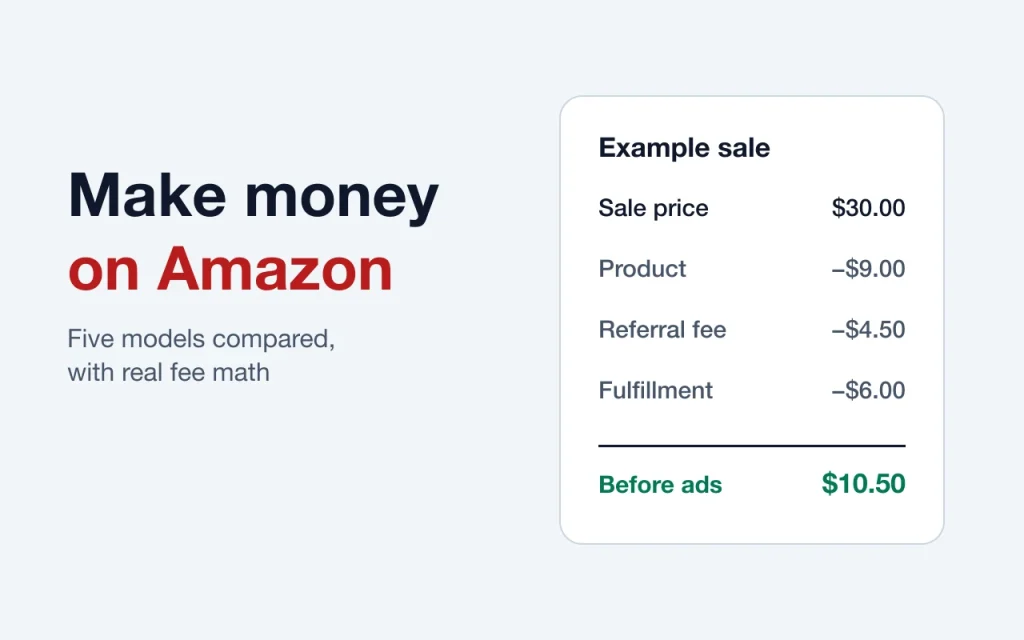
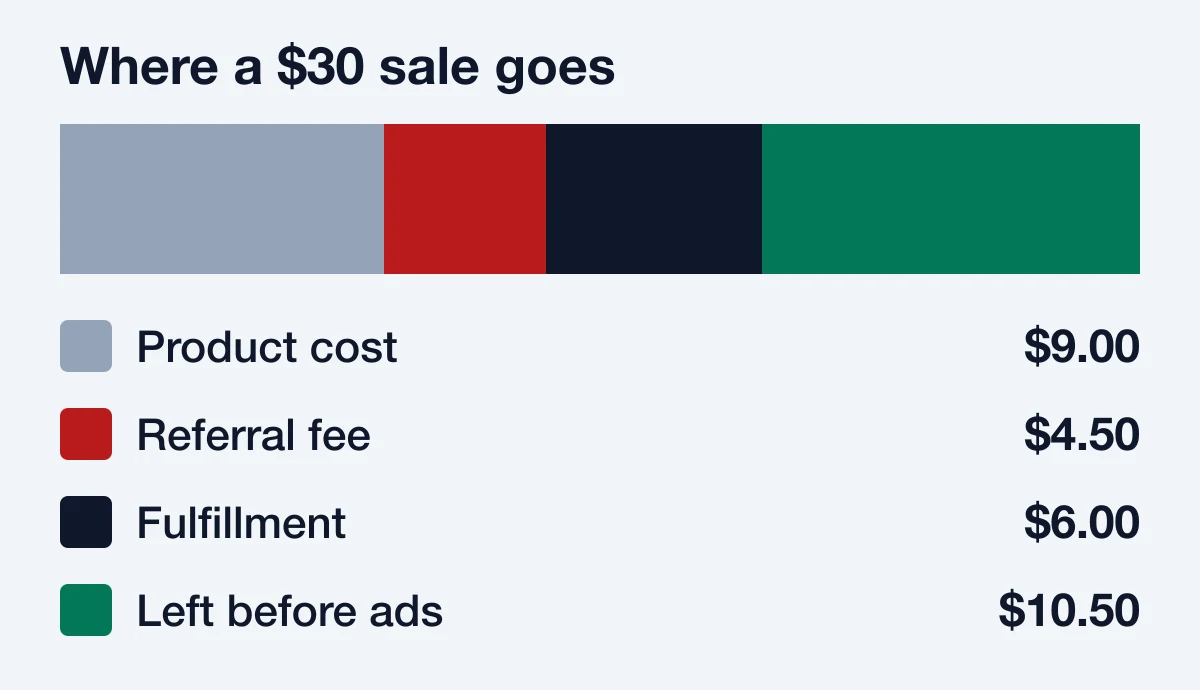
Here’s a worked example for a private label product on the Professional plan:
| Line | Amount |
|---|---|
| Sale price | $30.00 |
| Product cost, delivered | −$9.00 |
| Referral fee at 15% | −$4.50 |
| Fulfillment (example) | −$6.00 |
| Profit before ads and returns | $10.50 |
Those product and fulfillment figures are examples, so use your own. Ad spend and returns still have to come out of that $10.50, which is why a product that looks fine on paper can lose money in practice. Run your own numbers before you place a stock order.
How to choose a model
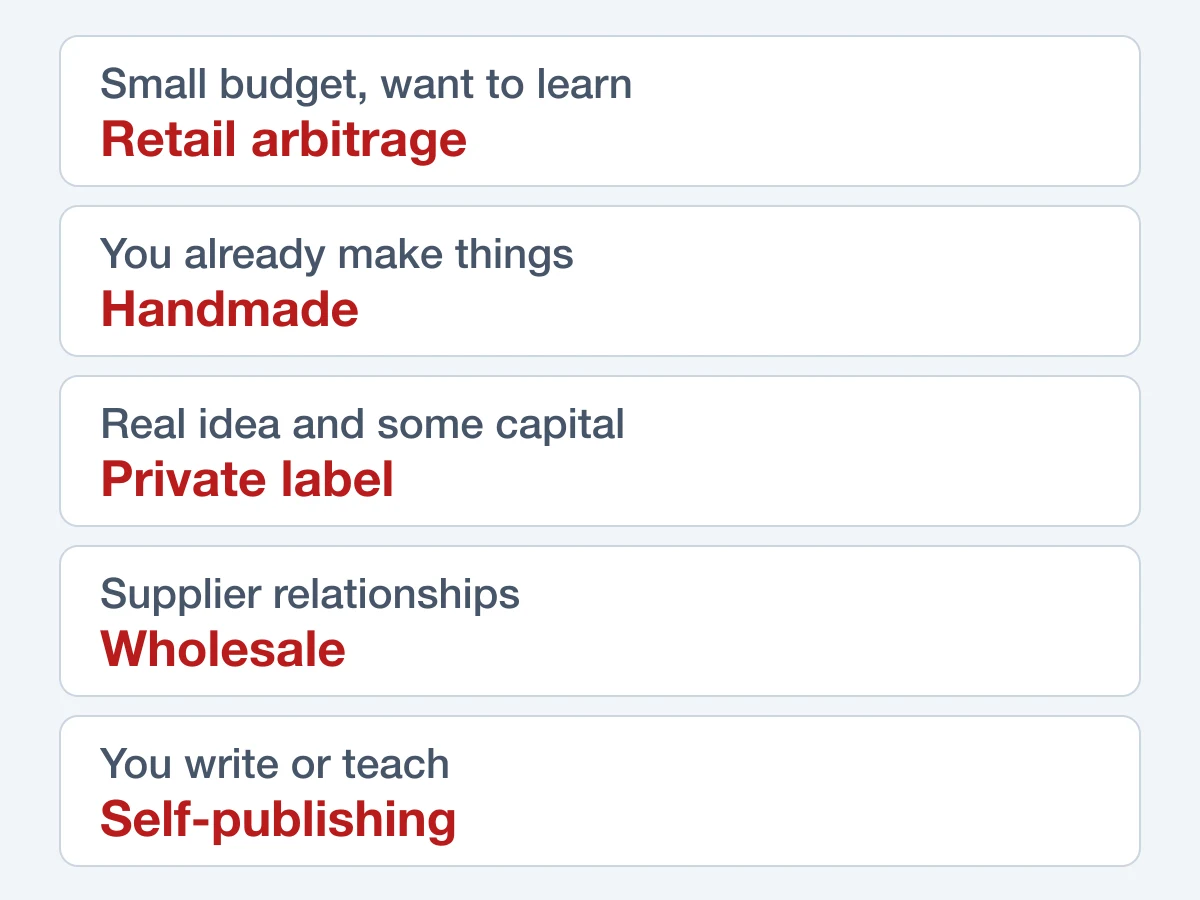
- Small budget, want to learn? Start with retail arbitrage, or with a small test of a product you can make.
- You make things already? Apply to Handmade.
- You have a real product idea and some capital? Go private label, but start with a small order.
- You have supplier relationships? Wholesale can work well.
- You write or teach? Try KDP. It has the lowest upfront cost of the five.
How to pick a product that can make money
Whichever model you choose, a good product tends to share a few traits:
- Room for margin. If your landed cost is more than about a third of the selling price, fees and ads get tight.
- Easy to ship. Small, light and hard to break keeps fulfillment and return costs down.
- Steady demand. Look for regular searches rather than one seasonal spike.
- A reason to choose you. You need something better than “same as the others but cheaper.”
Mistakes that eat your profit
- Ordering a large first batch before you’ve tested demand.
- Ignoring storage fees on slow stock. Amazon charges more on inventory held over 181 days.
- Picking a product only because a course said it was hot.
- Launching with a weak listing and paying for ads to make up for it. Our tips for getting more Amazon sales show what to fix first.
- Buying cheap product IDs without checking whether they’ll pass on Amazon.
Frequently asked questions
How much money can you make selling on Amazon?
It varies too much for an honest single figure. Some sellers earn a side income, some build real businesses and many make little or lose money. Your margin and your sales volume decide it, so estimate both before you start.
Can I start selling on Amazon with no money?
Not quite, but you can start small. Selling items you already own on the Individual plan costs $0.99 per item plus selling fees. KDP has very low upfront costs too.
Do I need an LLC to sell on Amazon?
Amazon doesn’t list an LLC among its requirements, but it does ask for a business license or registration on its sign-up list. Tax and liability choices are worth discussing with an accountant or lawyer.
Is Amazon FBA worth it for beginners?
Often, yes, because Amazon handles storage, shipping, customer service and returns. Check the fees on your specific product first. Our guide on how to start selling on Amazon covers the setup.