If you are a seller on Amazon, then you should pay attention to this post.
First, let’s understand one the about UPC Codes: it is used as a unique ID for every single product listed on Amazon. They help track and manage inventory. In simpler words, it’s like giving each item a specific number to identify with.
Originally, UPCs were the standard format. But as demand for UPCs increases in other countries like Europe, Asia, and Australia, an issue comes out: how to differentiate the products originating from different locations. That’s when GS1 came into the picture. They added country codes to the beginning of the standard UPC, allowing for better distinction across regions.
Why Buy UPCs for Amazon?
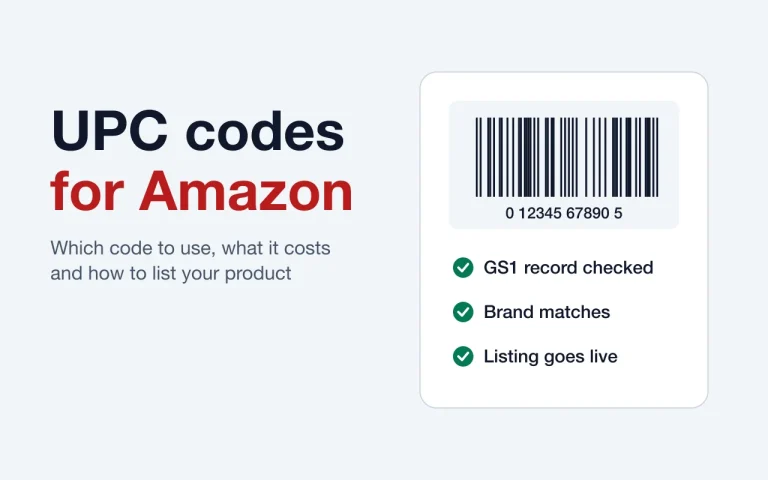
Amazon requires a GTIN, such as a UPC, for most new product listings, unless the seller gets a GTIN exemption. With that being said, sellers can either invest in legitimate Amazon UPCs directly from GS1 or go through a reseller. Various UPC and EAN resellers out there will try to sell replicated UPCs to satisfy Amazon’s UPC needs. Many sellers purchase their UPCs for Amazon from third-party websites due to their cheaper prices; however, using resold Amazon UPCs will cause more harm than good in the long run.
A typical process of how to get a UPC (code) number having 12 digits is as follows:
- License a unique Company Prefix from your local GS1 office.
- Assign product numbers to unique products making your equal 11 digits.
- Using a check digit calculator with your 11-digit number, generate your check digit.
UPC Sizing Requirements
UPC sizes are referred to as magnifications or magnification factors. The nominal size of a UPC is 100% magnification factor or 1.469 inches wide (from the far left-hand side number to the far right-hand side number) by 1.02 inches tall (from the top of the barcode to the bottom of the human-readable numbers). The minimum size of a UPC is 80% magnification factor (80% of the nominal size) and the maximum size of a UPC is 200% magnification factor (200% of the nominal size).
UPC Coupon Codes
US coupons once carried a UPC next to a GS1 DataBar or GS1-128 barcode. Printed coupons now use GS1 DataBar only, with no UPC. Most of the main retailers will not accept their numbers and many online websites are preying on unsuspecting new companies. Quite simply, buying the “UPC Codes” from any organizations other than GS1 puts you at risk of acceptance by retailers. There may be smaller retailers and online marketplaces that do not require a unique GS1 Company Prefix.
Acquiring a barcode for your product is an easy four-step process:
Step 1: Apply for a GS1 Company Prefix.
Step 2: Assign a unique product number
Step 3: Determine how your product will display the barcode.
Step 4: Order your barcodes.
At the end of this simple tutorial, you will be provided information on obtaining a UPC barcode with a unique GS1 Company prefix assigned to your company.
The Usefulness of Using GS1 Barcode for Amazon
As an Amazon seller, one should already be familiar with UPCs and what they entail. There is only one legitimate producer of Amazon UPC codes that exists globally, GS1 has set the global standard for supplying chain barcoding. GS1 issues every product supplier with GTINs (Global Trade Item Number). There are many sites to buy cheap UPC codes.
What is GS1?
GS1 is a not-for-profit organization that develops and maintains Global standards for business communications. The best known of these standards is the barcode, a symbol printed on products that can be scanned electronically. GS1 barcodes are scanned more than 10 billion times every day.
GS1 has member organizations in more than 110 countries and serves over 2 million companies. GS1 standards are designed to improve the efficiency, safety, and visibility of supply chains across physical and digital channels in more than 25 industries. They form a business language that identifies and captures and also shares key information about products, locations, assets, and more. So, one must know where to buy UPC code.
History of GS1
In 1969, the retail industry in the US was searching for a way to speed up the check-out process in shops. The Ad Hoc Committee for a uniform Grocery Product Identification Code was established to find a solution.
In 1973, the Universal Product Code (UPC) was selected by this group as the first single standard for unique product identification, and in 1974, the Uniform Code Council (UCC) was founded to administer the standard. On 26th June 1974, a pack of Wrigley’s chewing gum became the first ever product with a barcode to be scanned in a shop.
In 1976, the original 12 digit code was expanded to 13 digits, which opened the doors for the identification system to be used outside the U.S. In 1977, the European Article Numbering Association (EAN) was established in Brussels and with founding members from 12 countries.
In 1990, EAN and UCC signed a global cooperation agreement and expanded overall presence to 45 countries. In 1999, EAN and UCC launched the Auto-ID Centre to develop Electronic Product Code (EPC) enabling GS1 standards to be used for RFID.
In 2004, EAN and UCC launched the Global Data Synchronisation Network (GDSN), a global, internet-based initiative that enables trading partners to efficiently exchange product master data.
In 2005, the organization was present in over 90 countries which started to use the name GS1 on a worldwide basis. Whilst “GS1” is not an acronym it refers to the organization offering one global system of standards.
Standards
Main GS1 standards follow:
- ALE
- CBV
- EAN/UPC barcodes
- EPC/RFID tags
- EPCIS
- GDSN
- GDTI
- GIAI
- GINC
- GLN
- GPC
- GRAI
- GS1 Data Bar
- GS1 Data Matrix
- GS1 EANCOM
- GS1 EDI
- GS1 Smart Search
- GS1XML
- GSIN
- GSRN
- GTIN
- HF AIR Interface
- LLRP
- SSCC
- TDS
- TDT
- Traceability
- UHF Gen2 Air Interface
If you are looking to buy UPC Code for Amazon or Any other marketplace, you can buy from one of the best legit sites.
Conclusion
One should buy UPC codes from GetUPCCode securely with PayPal or Razorpay. This is a secure payment service. One of the most trusted brands in the industry. Our support team replies to emails within 24 hours, so you can ask questions before buying UPC codes.
Frequently asked questions
Why do marketplaces ask for a UPC code?
A UPC lets a marketplace match the same product across every seller who offers it, so shoppers see one listing instead of dozens of duplicates. It also helps the marketplace check that the product is genuine.
Which marketplaces require a UPC?
Amazon asks for one on most new listings. eBay asks for product identifiers but lets you choose “Does not apply” when an item has none. If you only sell on your own website, a UPC is optional, though it helps with shopping feeds.
What do the 12 digits of a UPC mean?
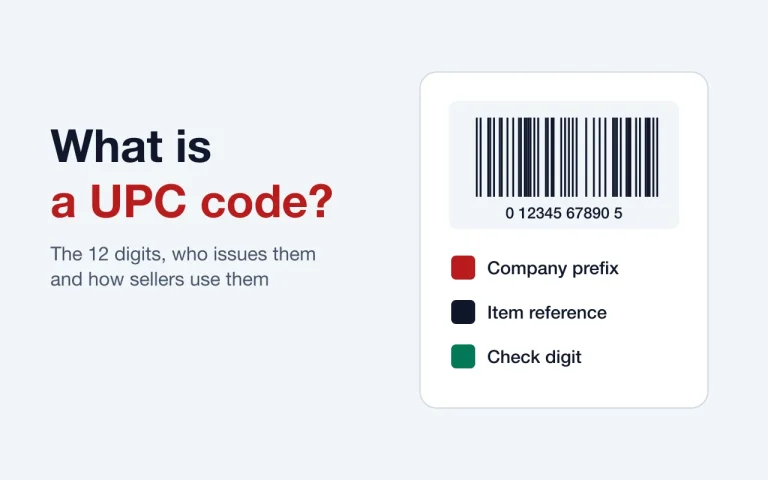
The first digits are the company prefix, the middle digits identify the item, and the last digit is a check digit calculated from the others. You can verify any code with our UPC check digit calculator.
What is GS1?
GS1 is the non-profit organisation that runs the barcode system used worldwide. GS1 US licenses UPC company prefixes in the United States, and a single GTIN from GS1 US costs $30 with no renewal fee.
Can I make the barcode image myself?
Yes. Once you own a code, you can create its barcode image with our free barcode generator and print it on your packaging or labels.