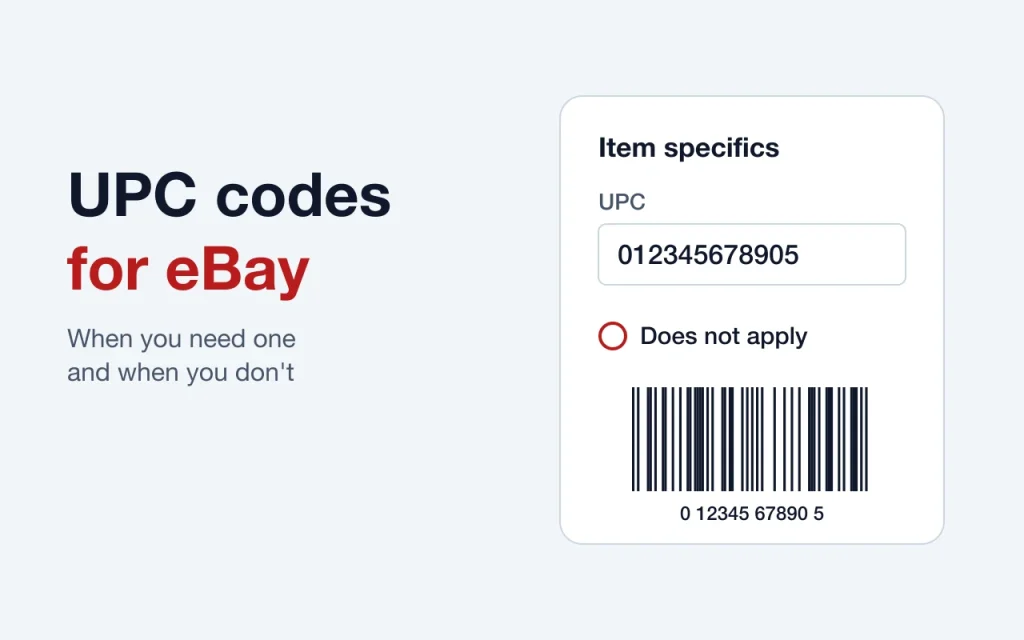
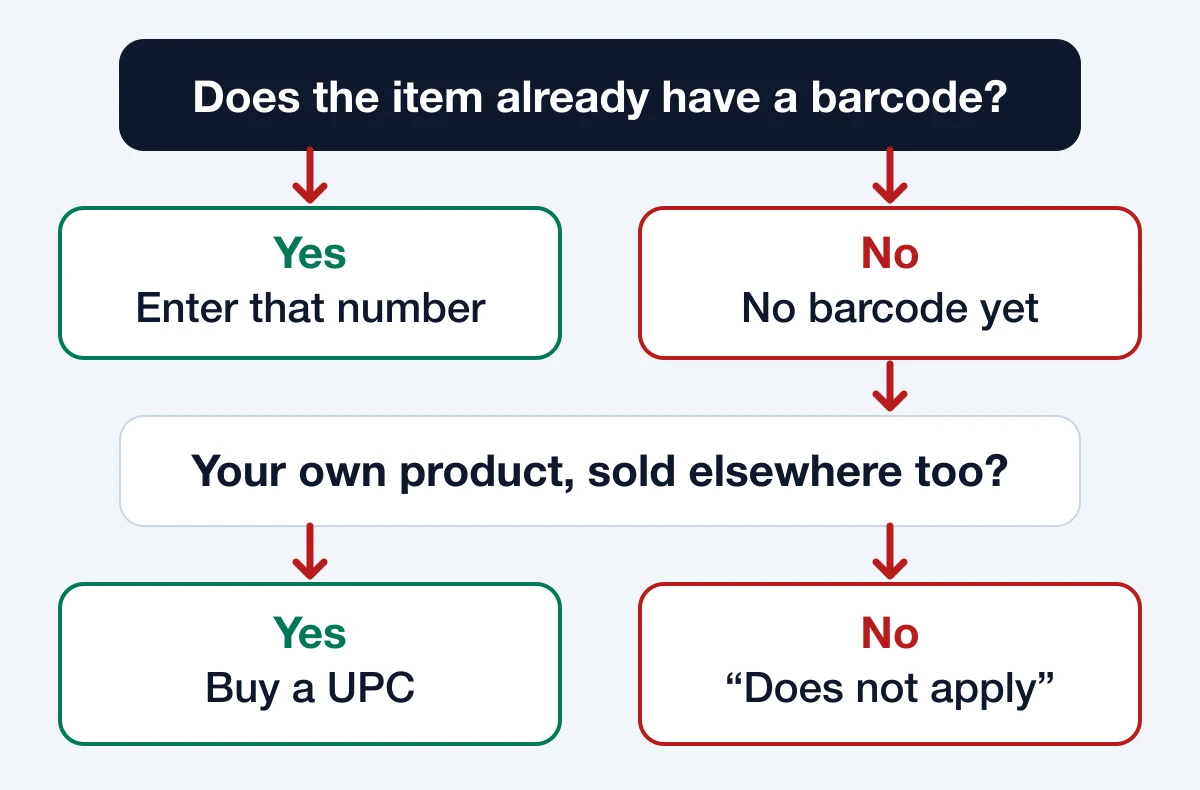
eBay asks for product identifiers such as a UPC in most categories, but you don’t always have to buy one. If you’re selling something that already has a barcode, you enter the number printed on it. If your item has no identifier, eBay lets you select “Does not apply.” You only need to buy a UPC when your own product will be sold somewhere that needs one, or when you want it to have a proper product number from the start.
We sell UPC codes, so keep that in mind. This guide tells you when you need one, and it also tells you when you can save your money.
What eBay actually requires
According to eBay’s page on product identifiers, they “are required when you’re listing in most categories on eBay.” eBay names UPCs, ISBNs and Manufacturer Part Numbers among them, and it keeps a list of the categories where they’re required or recommended.
The same page gives you a way out. For products that don’t have an identifier, such as antiques, you can select “Does not apply.” So the rule isn’t that every listing needs a barcode. The rule is that if an identifier exists, you should enter the right one.
eBay’s reason for asking is practical. It says identifiers increase “the chances of a buyer finding your item” and give buyers a way to find and compare what’s available. It also says a correct catalog entry could help reduce return requests, because the buyer sees exactly which product they’re getting.
Which situation are you in?
Most eBay sellers fall into one of four groups, and each one has a different answer:
| What you’re selling | What to enter | Should you buy a code? |
|---|---|---|
| Another brand’s product, new or used | The UPC printed on the package | No |
| A book | The ISBN | No |
| A vintage, antique or one-off item | “Does not apply” | No |
| Your own product, sold only on eBay | “Does not apply,” or a code if you have one | Optional |
| Your own product, also sold elsewhere | Your UPC | Yes, one per variation |
That last row is where a code earns its keep. If your product will also go on Etsy, Shopify or Google Shopping, one number across all of them keeps your records clean. If Amazon or Walmart is part of the plan, read the section on those channels below before you buy.
How to enter a UPC on an eBay listing
Add the code in the listing form’s product identifier field, which sits among the item specifics. Enter all 12 digits, including the smaller digits printed at the far left and right of the bars. Leaving those out is a common mistake, and the number won’t match.
Then check what eBay shows you. When you enter a number, eBay may match it to a product in its catalog. Read that match carefully. If it’s your exact item, you can use the details it fills in. If it’s a different product, stop. eBay’s advice is to “only use product identifiers that exactly match the product you’re selling,” and selecting something slightly different risks misleading the buyer.
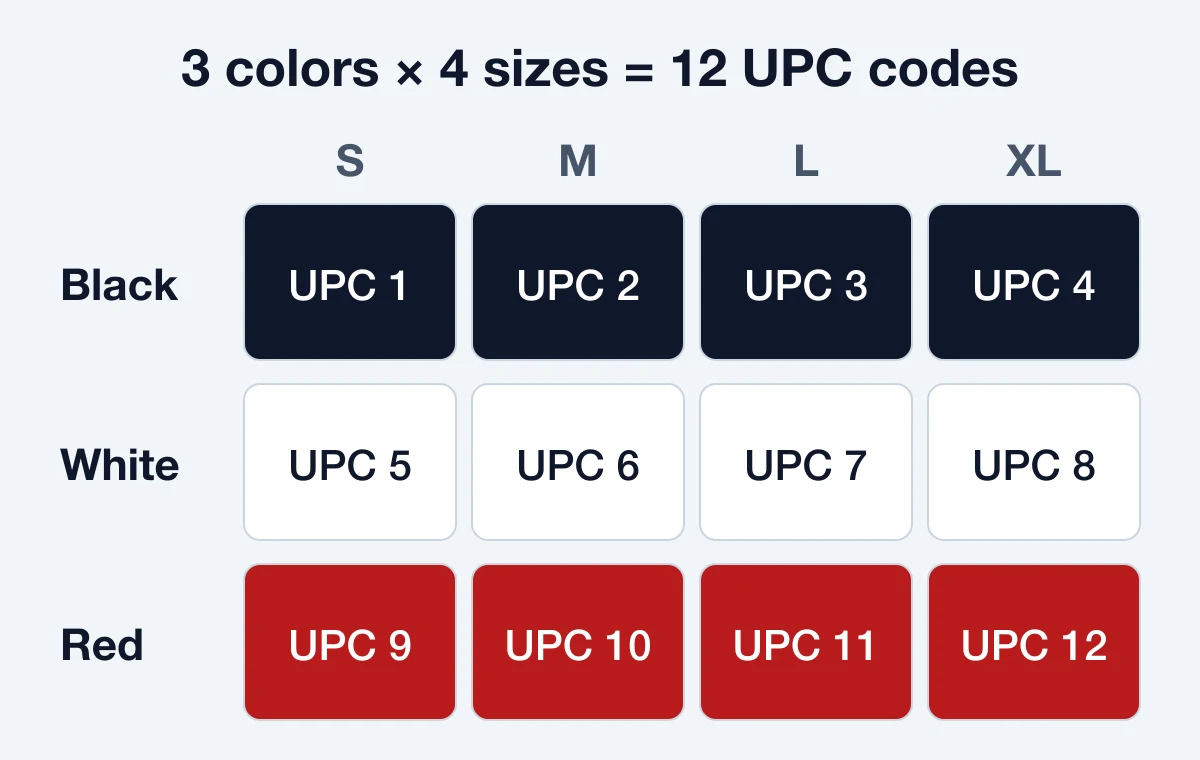
On a variation listing, each option can carry its own identifier, so a shirt listed in three colors should have three UPCs.
How many UPC codes you need for eBay
You need one code for each version of a product a buyer could tell apart. Stock quantity doesn’t matter. Twenty black shirts all share one UPC, and so do 20 more next month. A black shirt and a white shirt need different codes.
- New code: each color, size, flavor, scent or pack size.
- Same code: every unit of that exact version, however many you sell.
- Reused code: never. Once a number is on a product, it stays with that product.
A T-shirt in 3 colors and 4 sizes needs 12 codes. Our guide to how many UPC codes you need covers bundles and multipacks, which are the cases that trip people up.
Do reseller UPC codes work on eBay?
Yes, for the job eBay asks them to do. eBay needs a valid number that identifies your product, and it doesn’t ask you to prove who licensed it. A reseller code is a real 12-digit UPC, so it suits a seller whose own product needs an identifier.
There’s one trade-off. A reseller code isn’t registered to your company in GS1’s database. Look it up and you’ll see the company that first licensed the prefix. eBay doesn’t check this the way some channels do, so it rarely matters here. It can matter if you later move to a channel that does check.
Be careful with cheap codes sold on eBay itself. You can’t tell where those numbers came from or whether someone else is already using them. The same goes for free online number generators. A generated number can pass a format check and still belong to another product.
If you also sell on Amazon or Walmart
This is where buying the cheapest code can cost you more. Amazon checks product IDs against GS1 data, and Walmart cross-checks identifiers with GS1 and recommends getting them directly from GS1. If either of those is your main channel and you own the brand, buy from GS1 US and use that same code on eBay. A single GTIN is $30 with no renewal fee.
The strictest channel you sell on should decide your code. Our UPC codes for Amazon guide explains that decision in detail, and the calculator below shows what each choice costs for your product count.
Your numbers
-
GetUPCCode
-
GS1 US single GTINs
-
GS1 US company prefix
Prices from GS1 US, checked October 30, 2026, and our current packs before coupons. A prefix shows a range because the last renewal may fall outside your years.
What UPC codes cost for eBay sellers
Here’s what the numbers look like for a small catalog, using GS1 US’s published prices and our current packages:
| Products | GS1 US single GTINs | GetUPCCode |
|---|---|---|
| 1 | $30 | $4.59 |
| 10 | $300 | $15 |
| 100 | $3,000 | $44 |
Neither option carries a yearly fee. For a seller who only uses eBay and their own site, the lower price makes sense. For a brand heading to Walmart or a retail chain, it doesn’t. Our UPC code cost guide has the full price list, including GS1’s company prefix.
Our orders usually arrive by email within 15 minutes, and within 6 hours at most, with your codes in Excel and PDF plus barcode label files. If you’d rather make your own images, our free barcode generator works with any code you own.
Frequently asked questions
Can I list on eBay without a UPC?
Yes, if your item doesn’t have one. Select “Does not apply” in the identifier field. If the item does have a barcode, enter the real number, because the listing is easier to find that way.
Do I need a UPC for handmade items on eBay?
Usually not. A one-off handmade item has no manufacturer’s identifier, so “Does not apply” is the natural choice. If you make the same product in volume and want to sell it through other channels too, a code starts to make sense.
Can I use the same UPC on eBay and Amazon?
Yes. A UPC identifies the product, not the marketplace, so the same item keeps the same code everywhere. That’s a good reason to choose a code that passes your strictest channel.
Where do I find the UPC on a product?
Look for the 12-digit number under the barcode on the back or bottom of the package. If you’re reselling a boxed item, it’s sometimes on a sticker on the outer carton.
Can I use one UPC for different items in the same listing?
No. Each variation needs its own number. Sharing a code between two different products means a buyer, or eBay’s catalog, could match the wrong one.